4 Years of Tracking an NA Miata: Cost Breakdown
Witness my pain!

In 2019 I got my first real job. I was extremely fortunate to begin my career working as a software engineer at Toyota, (shout out to 'em!) and naturally, about 5 minutes after the second paycheck hit, I started looking for a dedicated track car. It took me till the winter to save up, but the day after Christmas 2019 I bought a 1990 Mazda Miata with 180k on the odometer from a semi-retired custom motorcycle builder.
Those first beautiful moments with the car, which did not have a title, nor airbags, nor the 100 horsepower it should, were special – I was finally in possession of the rock upon which I would build my hobby of motorsport. As if I knew that this might not be the most profitable enterprise, I started tracking all my expenses from the very first purchase. Now, 4 years in, it's time to reflect on the pile of money I've set on fire.
Hasty Justification Before I Show You The Numbers
Look, the numbers are going to be bad. The amount of money spent is not small, and will look worse if you aren't familiar with motorsports. There were a number of things I could have done differently, which I will get into, but suffice to say motorsports is not cheap no matter what. I am fortunate enough that as an unmarried software engineer I had enough disposable income for the hobby, but your mileage will literally vary.
Furthermore, the costs I am about to show you are the all-in costs. This includes parts, service, driver equipment, gas, hotels, fees, etc.. If you only calculate the cost of the car and the parts, let me tell you, you are missing out on a lot of the expenses you will encounter. And as a final disclaimer, you can easily, easily spend much more than this. My costs reflect my budget and appetite for risk, you may have more budget or more appetite for risk.
Some people who are already involved in motorsports may ask: why would I bother reflecting on the cost? Wouldn't it be better not to log this kind of information, or not to look at it? Well, the primary reason I kept this data is that when I started doing track days, I didn't find a guide this detailed. I want this information to be publicly available so that I can tell someone exactly what they're getting into if they choose to go down this rabbit hole. I also want to share some s important lessons that I learned to help avoid some of the worst costs of it all.
~$560 per month, ~$1,400 per event for 14 events, a running cost of ~$400 per track hour
Skip down further if you want the TL;DR tips for spending less.
Pain: Quantified
Yes, $30,000. One new Camry, or a down-payment on a house somewhere far outside any place you'd actually want to live. Considered as a monthly cost, I could have had a weekend sports car of considerable quality alongside my daily. I told you it was going to be bad!
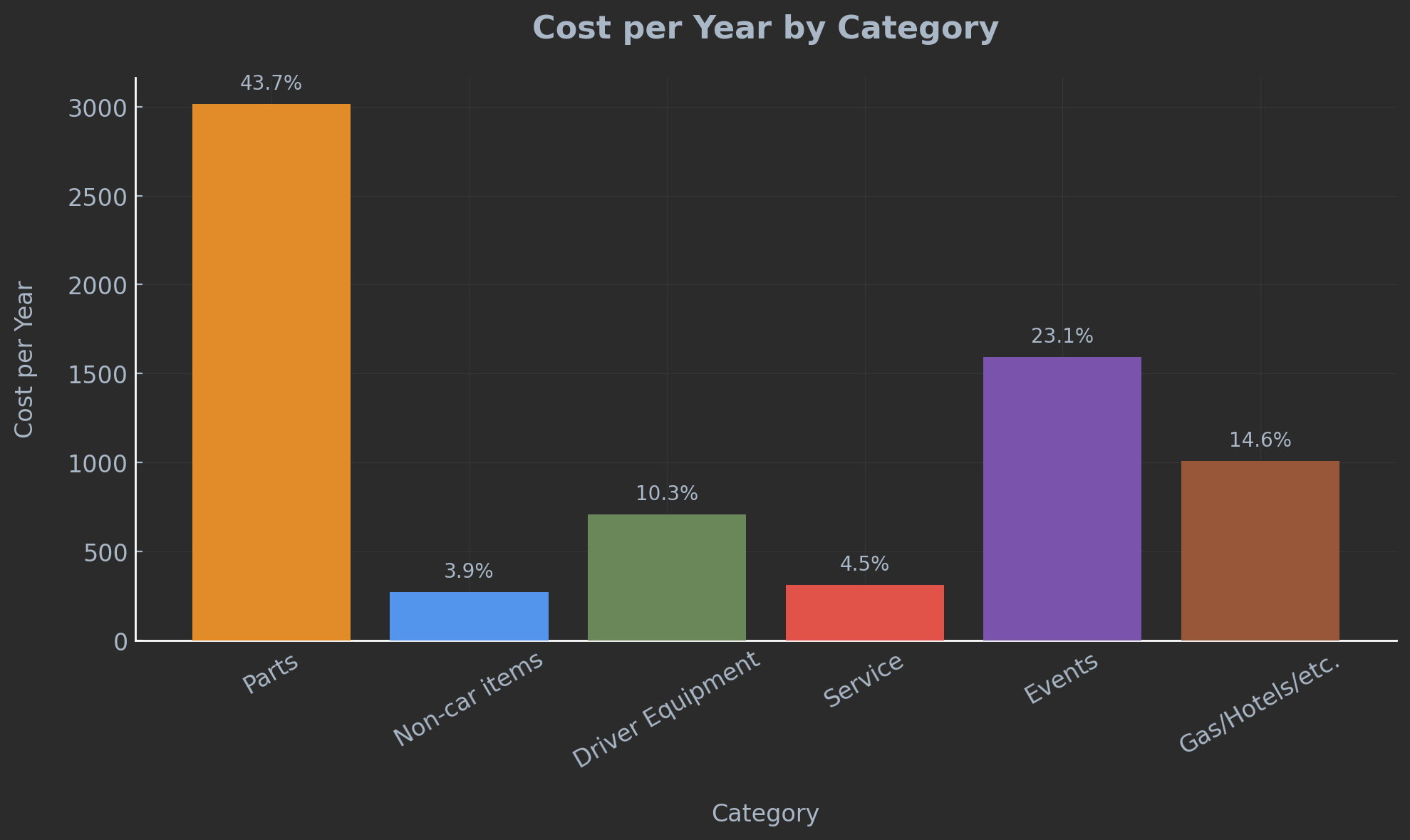
Primary painful stat out of the way, let's break down the costs and see where that money went. The spreadsheet in which I keep all my cost information tracks spending across several categories:
- Parts: All parts for the car, be they maintenance, performance, or otherwise.
- Service: Work done on the car by others.
- Driver Equipment: A GoPro, a data logger, my helmet, etc.. Things that are used for or by the driver directly.
- Non-Car Items: Canopy for the paddock, trailer service, tools, etc..
- Events: Registration fees, member fees, etc..
- Gas/Hotels/Etc.: Gas for the race car and tow vehicle, hotels to stay near the track, and anything that doesn't fall into one of the other categories..
- Base Cost of the Car: I bought my car without a title or roof at the absolute minimum of Miata prices (December 2019), so it was only $3,000 in cash running and driving with recent service.
Now, let's see what proportion of my overall spending was in each of the above categories:
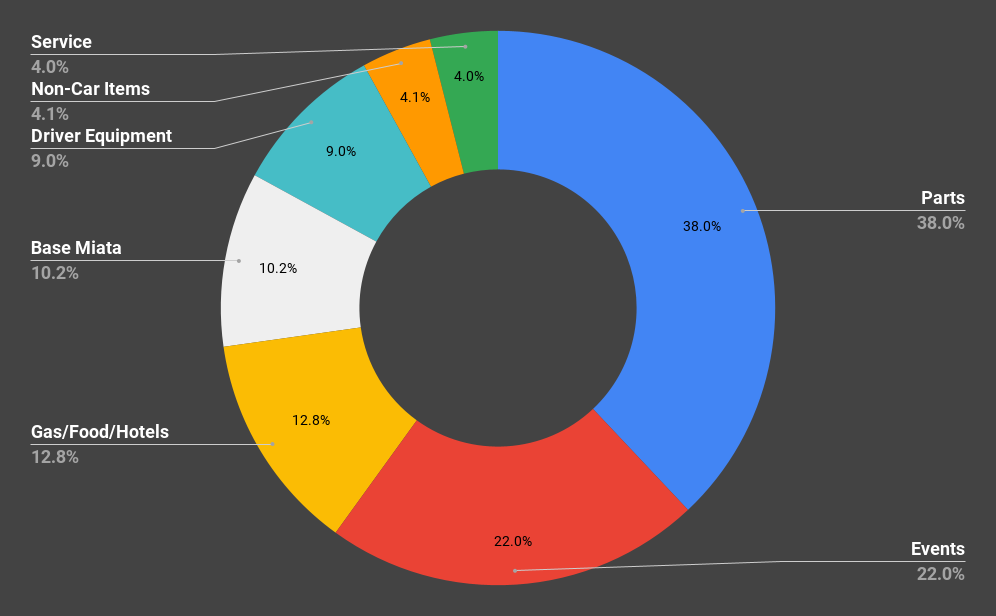
As you can see, the most expensive category at 38% is go-fast parts and maintenance items. There's a lot of fat to trim here, but top line is that if you buy an old car and beat the shit out of it, expect to spend money maintaining it. We'll come back to this later.
The next highest category at 22% is – and they really don't tell you about this one – event fees! Again, I'll talk later about ways to reduce this cost (or increase it!), but it's not uncommon for me to spend $400-600 per event just to be allowed in.
The next highest category at only 12% is gas, food, and hotels. It's worth mentioning again: the running cost of the car is only part of the expense of the track! If you drive way out to somewhere with a race track, you will want a comfortable enough bed, you will want to eat decent food, and so on. I went to the track by myself 99% of the time, so if you have a partner or family to bring with you, this cost will be much higher.
Then there's the cost of the car – at $3k it represents a little over 10% of the total cost, and this is your hobby entry fee. I bought what might be the cheapest possible track ready car, so unless you buy a similarly unloved but drivable vehicle, you can expect to spend a minimum of 2-4 times this amount. And just because you might be thinking it: while tempting, tracking your daily or a street car may not make better use of your money!
All other costs – service, random items to make the experience slightly better, driver safety equipment – were quite minimal compared to the running cost of the car and the cost to attend the events.

How Can I Spend Less Than That?
Okay, so ~$7,500 a year is a fair amount of money. Where could I have trimmed some fat?
Reliability Part 1: Buy a Car With Better Maintenance
The specific car I bought is pretty damn ratty – I'm something like the ninth or tenth owner. While a lot of service had been performed on the car when I bought it, this wasn't the best kept vehicle, and you could save on some of the maintenance costs by buying a car in better condition, thereby offloading some of those costs to the previous owner. That is – assuming they actually did maintenance!
Since buying the car I have done the following maintenance items:
- Brake Rotors: $40
- OEM Clutch Kit: ~$200
- OEM Fuel Pressure Regulator: $80
- Battery: ~$200 x2 (Don't let it die! Buy a battery cutoff!)
- FM Tail light bulbs: ~$45 (pair)
- TCM Front Hubs: ~$370 (pair)
- Shifter Rebuild Kit: ~$180
- Clutch Master + Slave Cylinder: ~$60
- Mishimoto Radiator Fans: ~$200 (Don't do this, use a single stock fan if it's going to live on the track)
Truthfully the combined cost of all of these (~$1,100) isn't horrible for 4 years, but if you can't (or don't) do your own wrenching, the maintenance cost will be much higher, especially on items like the clutch, new engine install, etc..
Reliability Part 2: Just Pay For an Engine Rebuild
This is the single biggest area where I could have saved on parts cost. When I bought the car it had 180k miles on the original engine. It ran great! But when abused on track, it spun a bearing after a few track days.
Interested in cheaping out, I bought a $700 used 1994 1.8L engine with 90k miles off Craigslist from a fellow enthusiast. I redressed the motor on the outside with all new seals, gaskets, a new oil pump, new timing belt, etc. ($1,200 because I also paid for the kit from FM for swapping a 1.8 motor into a 1.6 car) only for it to blow on track after 2 more weekends.
Deterred slightly, but still trying to cheap out, I purchased an ~$800 used 1994 1.8L former Spec Miata engine from a gentlemen who said it was in good working condition when removed, only to find that... well... it was blown up too. We are now up to 3 blown engines and a total cost of engine cores and parts of $2,200!
It was at this point I started to suspect that perhaps cheaping out on my engine was not the right approach.
There's an old saying in Tennessee—I know it's in Texas, probably in Tennessee—that says, 'Fool me once, shame on...shame on you. Fool me—you can't get fooled again.
- George W. Bush, on engine rebuilds
At this point I paid for X-Factor Racing, a dedicated Spec Miata shop, to rebuild and install one of my 1.8L engine cores. They charged $4,200 for the an OEM rebuild – albeit with forged rods and a FluidDamper – along with installation and tuning, which was about what Track Dog Racing quoted me just for the build. (I love the guys at TDR, just pointing out I felt I was getting a good deal at $4,200 installed.)
This was the best money I have yet spent on my car! This engine has, so far, held up quite well and it has allowed me to get the seat time I'd been paying for. The stress relief also is worth its weight in gold.
If I were to do it all over, I would not hesitate to have the engine rebuilt on day 1. Having the peace of mind that the engine is healthy, and being able to beat on it on track for hours at a time without worry, has been the single biggest advantage I have given myself to date. If I had just paid the $4,200 up front, and avoided buying a second unnecessary engine core, I could have saved about $2,000, or roughly 20% of my overall parts cost.
Reminder also that I swapped the first two engines with my uncle in his garage, so if you had this experience and were paying someone else to do it each time... let's just leave it at that.
Buy Less Go-Fast Parts
You aren't going to do this, but I had to say it.
Stay at Worse Hotels, Camp at the Track, Cook Your Own Food
If you have a family coming with you, or significant other you feel strongly about, kiss this one goodbye. But if you're like me and single, you could conceivably camp at the track or stay in a really cheap motel. Admittedly this is an area where I paid an extra ~$200 a weekend or more for luxury, but looking back on it I don't regret it. Driving on track takes a lot of mental bandwidth, and the more you have available because you had good sleep, good food, and good company, the better.
Calibrate Your HPDE Host
Just to say up top, I have loved every host I've been with on track. Each of them has their own culture, and you may find that one group gels with you better than others. For me, I've always felt amazingly welcome at NASA Texas events.
That said, if you're starting from scratch it's worth taking stock of who in your area does track days, what each of them is good at, and where your dollar will go the furthest. Here's a table comparing the cost per track hour (in registration fees only) for several HPDE organizations in my area:
| Group | Cost Per Track Hour | Notes | Link |
|---|---|---|---|
| Edge Addicts MSR Cresson | ~$100 | No longer available | n/a |
| Chin Track Days | ~$120 | Only ECR | https://chintrackdays.com/ |
| APEX HPDE | ~$130 | https://www.apexhpde.com/ | |
| NASA Texas | ~$170 | https://nasatx.com/ | |
| Edge Addicts COTA | ~$390 | Just for comparison | https://www.edgeaddicts.com/ |
Seems like Chin Track Days is the best right? Well, not so fast: In my area they only run at ECR, so that means I must go with another host if I want to visit MSR Cresson. Furthermore, Chin doesn't have a TT option, so if like me you're looking to step up into competition, they can't help you.
As a corollary: seems like NASA Texas is super expensive, and in my region you definitely get less track time with them than with Chin! Why go with them? Well, they have racing you can watch, racing drivers you can talk to, and TT you can compete in when you're ready. NASA events have always been a blast, and the racers who've been doing it a while are amazing mentors, teachers, and instructors. (As an aside, your significant other or family may be happier with racing to watch!)
My primary guidance here is to calibrate your host to what you want to do at the track, and that will help you keep costs under control. And to build on that: always go to the track with a goal in mind. Here are some examples to help you choose:
- First day on track, trying to see if this hobby is for you? Go with a professional group, ideally one who operates club racing. NASA, SCCA, PCA, etc.. They will be the most serious about safety, and will have lots of fun people to talk to. Better to pay the cost your first few days.
- Just want to make sure your car runs right? Look for an HPDE only group, as cost is king, and get more track time per dollar.
- Want to step up into TT? Find a group with a class your car can fit into, and people and cars you want to compete with. Cost will be secondary to classing, although classing is also how you control cost.
If I had known that I would be spending two full years learning before TT or racing was even remotely something I was ready for, I would have spent more time with HPDE-only groups early on, and I could have saved a fair bit of money for later. Another reminder: if your car is unreliable, you might not get all 2-4 hours of track time you paid for! Poor reliability cost me a lot of money in parts and lost track time.

Things You Might Be Tempted to Do to Save Money, But Shouldn't
Okay, so armed with tips to avoid some of my worst mistakes, you're ready to buy a track car and commit to setting large portions of each paycheck on fire. Great! Here are some things you definitely should not do to save money, though they will be tempting:
Don't Take Your Expensive Daily/Weekend Car on Track
You may be tempted to say, "well I have a cool car already, I'll just drive that to the track!" And I mean, if you have more money than me, maybe you can get away with this? The problem with tracking an expensive (or inexpensive) daily or weekend car is twofold:
For one, you really should be buying HPDE Insurance, and at least the two times I've tracked my '21 ND Miata, it wasn't exactly cheap – $500 a weekend and a $3k deductible. Driving a Camaro, Corvette, Porsche, etc.? Expect to pay a lot more.
And two, what happens if you put it in a wall, or have a major accident with another car? Accidents on track are pretty unlikely, but how will you get back to your home? Are you prepared to pay the fees the track will charge to clean up your mess? How are you going to go into work on Monday?
All of these problems can be solved with money and insurance, but the best way to mitigate all of that potential risk and cost is really just to buy a car that either mostly or exclusively lives on track. The cost can be higher, because you may have to tow the car, do extra maintenance, etc., but the risk goes down a ton and you will have significantly increased peace of mind.
Don't Do Serious Performance Mods Before Going to the Track
You will be so tempted, especially with a cool street car, to buy tons of performance parts before going to the track. I know I wanted to! But the best way to save on costs is to start with a stock vehicle, and upgrade the weak points of that vehicle as your skills improve. If you buy a cheap Miata (which would have held up ok on a factory engine,) and slap a turbo on it before your first track day, you're dramatically increasing the potential cost of a mechanical issue even on a cheap platform. Will you be happy you bought that awesome $1500 set of headers when you lose oil pressure and have to buy a new motor because you forgot to tighten the filter?
Don't Skimp on Safety Equipment!
It has to be said, but safety equipment is the literal worst place you could possibly try to save money. High performance driving is dangerous, and you could be seriously injured or killed even at an uncompetitive track day. If you don't have enough money for a good helmet, HANS device, good torque wrench for your lug nuts, good tires (which are performance and safety equipment!), etc. then you can't afford to go to the track, full-stop.

Closing Thoughts and Further Cost Data
$30,000 and 4 years later, was it worth it? Absolutely. I haven't had more fun doing anything else! The combination of skill and thrill of high performance driving, (even outside of competition!) has been an incredible passion of mine from the first sighting laps on my first track day, and while the cost has been high, I know I'll only get better at finding cost efficiencies over time.
As a final thought I'll leave you with this: a 1990 NA Miata with no title is quite possibly the cheapest, fastest road course car most people can maintain on a budget. Even then, the all-in cost of this hobby was still $7,500 a year. If you bought a Corvette, BRZ, Cayman, or anything else, you can expect to spend a lot more on average!
Should that dissuade you from tracking one of those cars? Not necessarily, but is M.I.A.T.A? I personally think so!
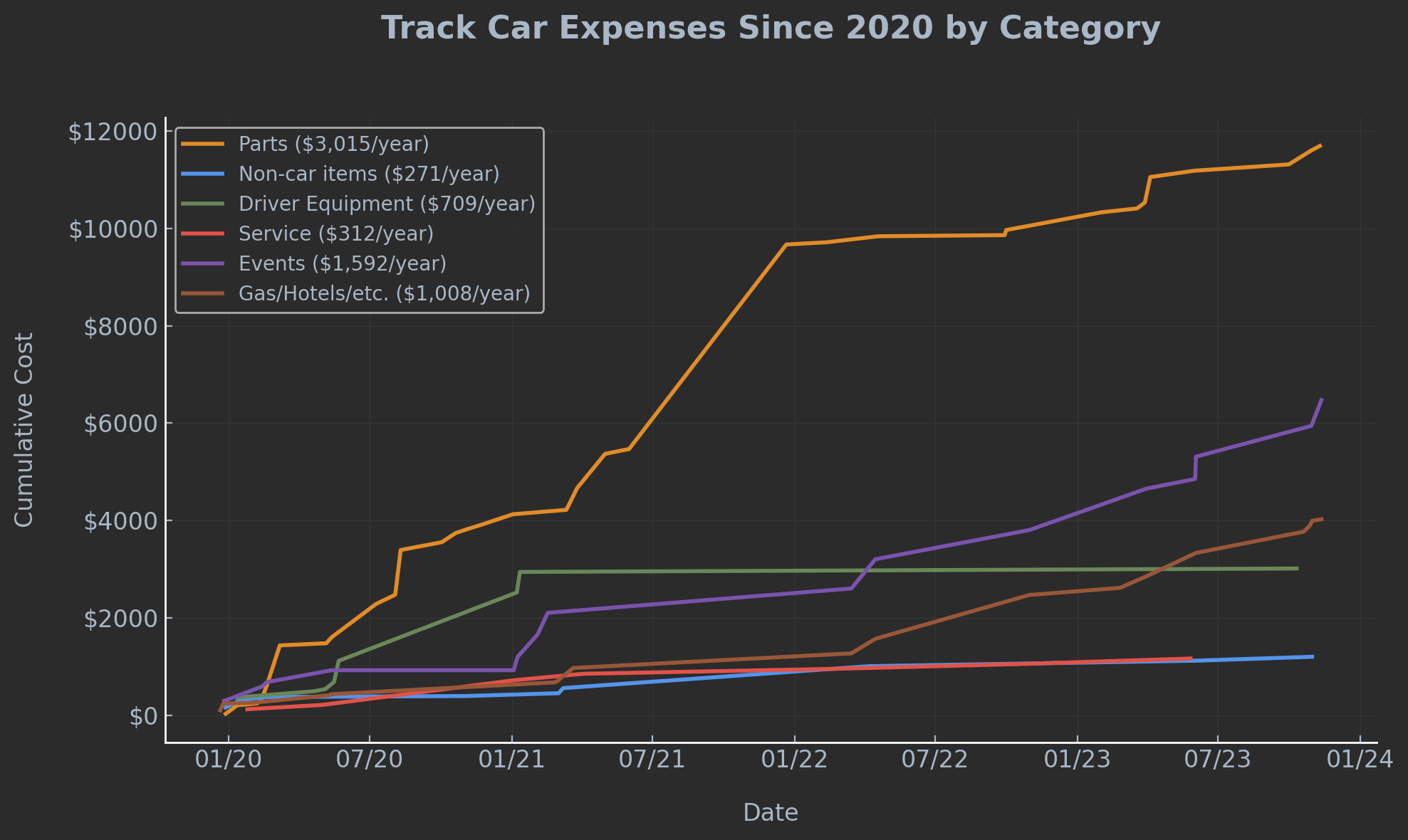
Additional Cost Data
And here's the raw spreadsheet: